
The Sequence Knowledge #842: Everything You Need to Know About World Models
Wrapping up our long series about world models.
💡 AI Concept of the Day: A Summary About Our World Model Series
Today, we conclude our series about world models. This series has been incredibly well received. Next week we will be starting a hot new series about transformers alternatives.
For the past few years, the artificial intelligence narrative has been dominated by large language models. We built systems that ingested the internet and learned to predict the next word with startling sophistication. But language, for all its structural beauty, is a low-bandwidth abstraction of reality. It describes the world, but it does not represent the ground truth of physics, causality, or spatial geometry. As we wrap up this series on world models for The Sequence, the fundamental takeaway is clear: the LLM revolution was just the prologue. The next frontier is Physical AI.
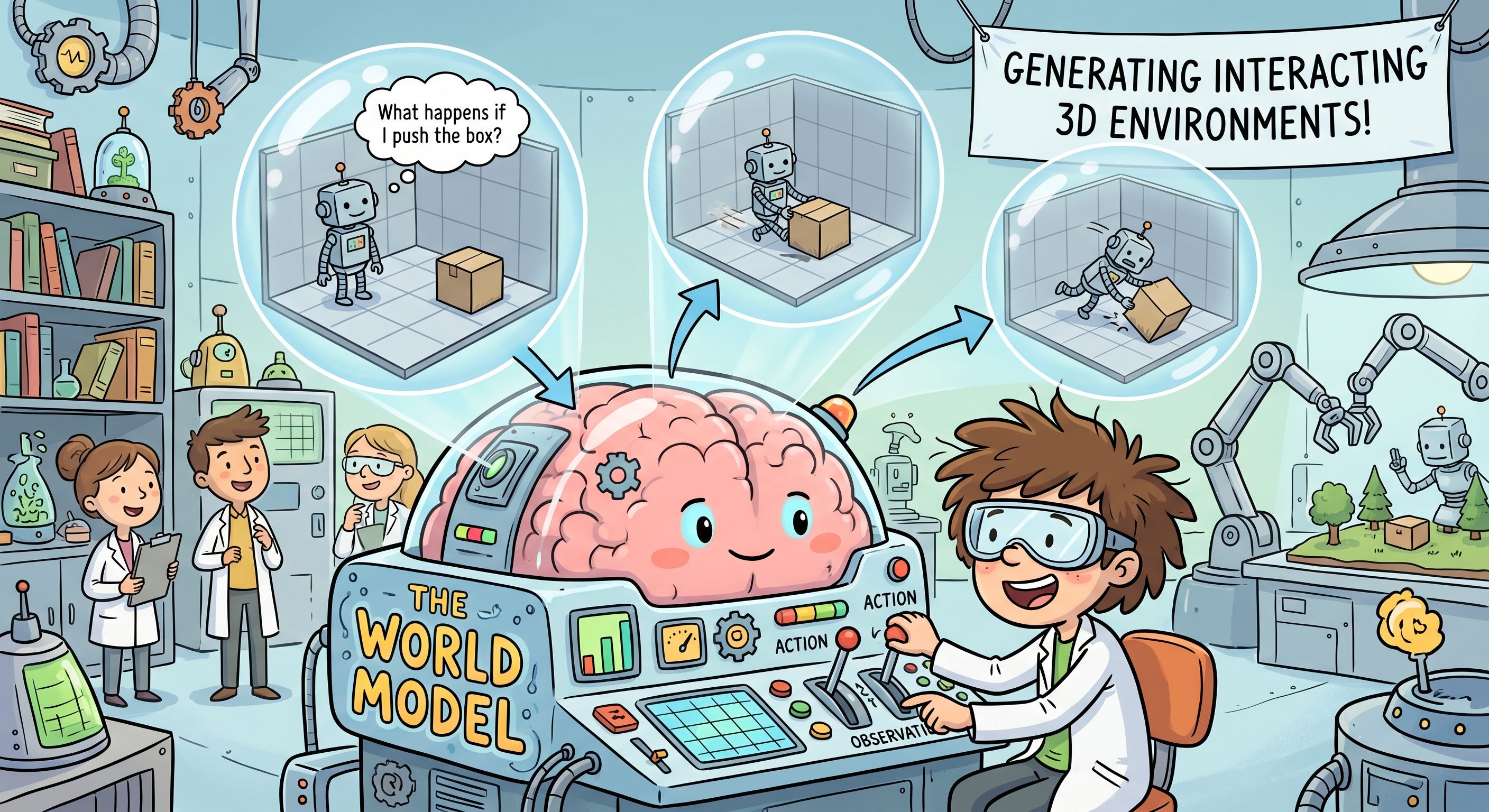
At its core, a world model is an internal simulator—a computational snow globe. Instead of predicting what the next sentence should look like, it predicts the next state of a dynamic system. If an embodied agent pushes a cup off a table, a world model doesn’t just output the text “the cup falls”; it mathematically represents the gravity, the trajectory, and the collision. This capability shifts AI from being a brilliant narrator to a competent operator.
The architectural leap we are witnessing in 2026 is profound. Throughout this series, we explored how diverse models are converging on spatial-temporal reasoning:
· We saw how approaches like D4RT reconstruct dynamic 4D environments, unifying perception and tracking into a single, highly parallelized queryable interface.
· We examined how World Labs’ Marble lifts multimodal signals into persistent, actionable 3D geometry, separating spatial structure from visual style to give developers unprecedented control over generated environments.
· We explored Google DeepMind’s Genie 3, demonstrating how foundation models can generate playable, action-controllable interactive environments from a single image.
· We looked at NVIDIA’s Cosmos, a massive world foundation model that compresses spatiotemporal reality into tokens, providing the “physics engine” needed for synthetic data generation at scale.
· And we traced the lineage of latent imagination through the Dreamer trilogy, proving that reinforcement learning agents can master complex behaviors entirely within the safety of their own “dreams.”
The implications of these breakthroughs are fundamentally reshaping the enterprise and robotics landscapes. The hardest problems in business and autonomy live in four-dimensional reality. Autonomous vehicles, surgical robots, and supply chain digital twins cannot rely on the brittle heuristics of purely text-based reasoning. They require an understanding of how systems change when an intervention occurs.
By providing a safe, physics-grounded environment, world models solve the critical data bottleneck of Embodied AI. Agents can now practice, fail, and adapt millions of times in a continuous “Sim-to-Real” loop before a physical motor ever turns. The talent and capital shift reflects this reality. From the emergence of specialized Vision-Language-Action (VLA) models to dedicated research labs focusing entirely on advanced machine intelligence grounded in the physical world, the industry is moving aggressively toward spatial intelligence.
We are no longer just building models that know things; we are building models that understand how things work. By unifying space, time, and causality into differentiable neural architectures, world models represent the missing link in the pursuit of generalized intelligence. The era of pure token prediction is giving way to the era of physical simulation, and the AI operating layer of the future won’t just chat with us—it will live in the world alongside us.
Here is a summary of our series:
1. The Sequence Knowledge #796: Introduces our series about world models and review the famous DayDreamer paper.
2. The Sequence Knowledge #800: Discusses the different types of world models and reviews the first major paper in the space.
3. The Sequence Knowledge #804: Covers the famous Dreamer models that opened up the space of world models.
4. The Sequence Knowledge #808: Dives into Meta AI’s famous JEPA architecture for world models.
5. The Sequence Knowledge #812: Discusses OpenAI’s Sora and the potential of video models as new physics engines.
6. The Sequence Knowledge #817: Reviews DeepMind’s amazing Genie models which are at the forefront of the world model revolution.
7. The Sequence Knowledge #821: Explore the idea of world models and 4D spaces including DeepMind’s D4RT research.
8. The Sequence Knowledge #825: Discusses one of the most innovative world models: World Labs’ Marble.
9. The Sequence Knowledge #829: Explores the idea of world models and physical AI including NVIDIA’s Cosmos models.
10. The Sequence Knowledge #833: Dives into the core architecture components and building blocks of world models.
11. The Sequence Knowledge #838: Dives into the recently announced Project GENIE.
I hope you enjoyed this series as much as we did putting it together. Our next series is about ALTERNATIVES TO THE TRANSFORMER ARCHITECTURE. Go subscribe :)