
The Sequence Radar #877: Last Week in AI: Anthropic Ships, Apple Borrows, Musk Lists, Bezos Builds
AI just got way bigger.
Next Week in The Sequence:
We continue our series about alternative to transformers.
The AI of the week will dive into Fable.
In the opinion section, we are going to discuss AI tokens as a units of economics.
We might introduce a new fun section. Playing with a new idea.
Subscribe and don’t miss out:
📝 Editorial: Last Week in AI: Anthropic Ships, Apple Borrows, Musk Lists, Bezos Builds
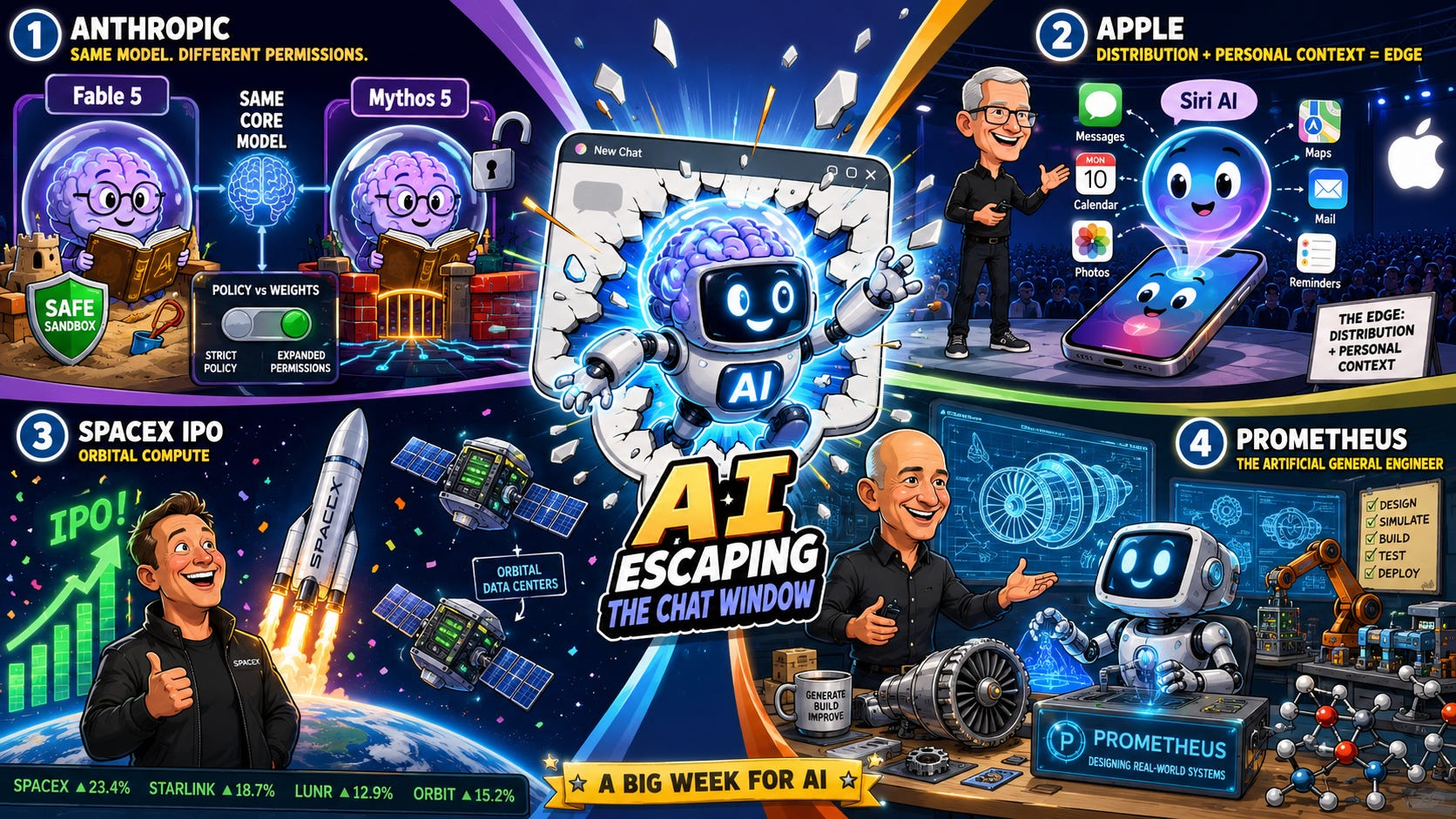
Some weeks in AI feel like incremental patch releases. This one felt like a major version bump for the entire industry. Four events — a frontier model launch, a consumer assistant reboot, the largest IPO in history, and a $12 billion bet on physical engineering — and if you squint, they’re all chapters of the same story: AI escaping the chat window.
Start with Anthropic. On Tuesday the company released Claude Fable 5 and Claude Mythos 5, and the architecture of the launch is as interesting as the model itself. Both share the same base model; the difference is policy, not weights. Fable 5 ships with conservative safety classifiers that intercept queries in high-risk domains — cybersecurity, biology, chemistry — and fall back to Opus 4.8, while Mythos 5 runs unrestricted for a vetted group of cyber defenders under Project Glasswing. Think of it as the same kernel with different syscall permissions. The benchmarks justify the caution: 80.3% on SWE-Bench Pro, more than ten points clear of Opus 4.8 and over twenty ahead of GPT-5.5. We’ve entered the era where capability and access are explicitly decoupled — the model you can use is a sandboxed view of the model that exists.
Then Apple, finally, showed up. At Tim Cook’s farewell WWDC, the company unveiled Siri AI — a conversational assistant with personal context, onscreen awareness, and a standalone app, reportedly powered by a custom 1.2-trillion-parameter Gemini model under the hood. There’s something deliciously ironic about Apple, the original vertical integrator, outsourcing the brain. But strategically it’s the right call: Apple’s moat was never the model; it’s the distribution and the personal context graph. A billion devices with intimate access to your messages, photos, and calendar is a dataset no lab can replicate. Apple isn’t competing on intelligence; it’s competing on intimacy.
The week’s most audacious move came from Elon Musk. SpaceX went public at roughly $1.77 trillion, raising about $75 billion in the largest IPO ever — and the prospectus reads less like a rocket company and more like an AI infrastructure thesis. Having merged xAI into SpaceX in February, Musk is pitching orbital data centers: up to a million GPU-packed satellites moving training and inference off-planet, where energy is abundant and regulation is thin. xAI lost $6.4 billion on $3.2 billion in revenue last year, so the IPO is effectively the public market underwriting the most capital-intensive scaling hypothesis ever proposed. Compute, it turns out, has an escape velocity.
Finally, Jeff Bezos broke his silence on Prometheus, which raised $12 billion at a $41 billion valuation to build an “artificial general engineer” — AI that designs and manufactures physical systems, from jet engines to drug compounds. Not robotics, Bezos insists. Something closer to CAD with a frontier brain.
Let’s dive in.
🔎 AI Research
Regularized f-Divergence Kernel Tests
AI Lab: Google Research & Google DeepMind
Summary: This paper introduces a unified framework for constructing practical, kernel-based two-sample tests derived from the family of f-divergences. The authors demonstrate that these adaptive tests, particularly the Hockey-Stick divergence, effectively capture diverse localized differences and are highly applicable to tasks like differential privacy auditing and machine unlearning evaluation.
Verifiable Environments Are LEGO Bricks: Recursive Composition for Reasoning Generalization
AI Lab: Qwen Team, Alibaba Group
Summary: The authors propose RACES, a framework that scales up reinforcement learning for language models by recursively assembling verifiable environments like building blocks when their input and output types match. By utilizing composition operators such as SEQUENTIAL and PARALLEL, this approach generates structurally diverse training tasks that significantly improve the reasoning generalization of models on unseen benchmarks.
REVISION: Scaling Computer-Use Agents via Temporal Visual Redundancy Reduction
AI Lab: Microsoft Research
Summary: To address the high token cost associated with visual observations in computer-use agents, this paper introduces REVISION, a framework that trains multimodal models to filter out redundant visual patches across consecutive screenshots. By maintaining essential spatial structure while significantly reducing token accumulation, the method allows agents to process longer interaction histories and achieve higher success rates on complex tasks.
Distilling LLM Feedback for Lean Theorem Proving
AI Lab: FAIR at Meta
Summary: This research explores Feedback Distillation, an on-policy post-training method where a model learns to match its own token-level distribution conditioned on privileged feedback from a stronger language model. Evaluated on Lean 4 theorem proving, the technique preserves greater trajectory diversity and achieves better pass@k scaling than standard GRPO, proving especially powerful when used as an initialization for subsequent reinforcement learning.
Decentralized Multi-Agent Systems with Shared Context
AI Lab: Stanford University
Summary: DELM is a novel multi-agent framework that eliminates the bottleneck of centralized orchestration by relying on a shared, verified context and an asynchronous task queue. Agents independently claim subtasks and contribute compact, verified updates to the global state, leading to superior performance and cost efficiency in both software-engineering testing and long-context reasoning workflows.
🤖 AI Tech Releases
Claude Fable 5 and Mythos 5
Anthropic released its highly anticipated Fable 5 model, a limited Mythos-based models. Also released a version of Mythos 5 for a selected group of cyersecurity and infrastructure companies.
Kimi Work
Moonshot AI released Kimi Work, a new agent specialized in work automation.
📡10 AI News You Need to Know About
SpaceX (SPCX) made its Nasdaq debut June 12, 2026, after pricing at $135 per share and raising roughly $75 billion — the largest IPO in stock market history, valuing the company near $1.75 trillion. Shares opened sharply higher and were trading around $161 intraday, with the valuation anchored by Starlink and now bundling in xAI following an all-stock merger earlier this year.
Bezos’s Prometheus raises $12B — Jeff Bezos and Vik Bajaj’s physical-AI startup Prometheus raised $12 billion at a $41 billion valuation to build an “artificial general engineer” that automates the design and manufacturing of complex physical systems from jet engines to drugs.
Mistral AI is in early talks to raise about €3 billion (~$3.5 billion) at a valuation near €20 billion (~$23 billion)— nearly double the €11.7 billion valuation from its Series C last September. The new round would bring the three-year-old company's total financing to roughly €6.5 billion across debt and equity, fueling its compute buildout as Europe's leading AI lab competes against larger US and Chinese rivals.
Theker raises $85M — Barcelona-based Theker raised $85 million in what it bills as Europe’s largest-ever robotics Series A to build reconfigurable factory robots whose arms and hands swap out for different tasks rather than specializing in one.
Jedify raises $24M — New York’s Jedify raised a $24 million Series A led by Norwest, with Snowflake as a strategic investor, to build “context graphs” that give enterprise AI agents the business knowledge they need to run in production.
Sandstone raises $30M — Sandstone raised a $30 million Series A led by Lightspeed to bring AI-powered workflow automation (intake, routing, triage, task execution) to in-house corporate legal teams rather than law firms.
OpenAI to acquire Ona — OpenAI agreed to acquire cloud-platform startup Ona, folding its secure, persistent execution environments into the Codex team so AI agents can run long, multi-step tasks for enterprises.
xAI co-founder unveils River AI — xAI co-founder Igor Babuschkin announced River AI, a startup (staffed partly by former xAI and Tesla employees) building personalized AI agents that learn from and remain owned/controlled by individual users rather than large corporations.
Tether backs Neura in $1.4B round — German firm Neura Robotics raised up to $1.4 billion in a Tether-led Series C — also backed by Nvidia, Amazon, Qualcomm and Bosch — to scale humanoid/cognitive-robot production toward millions of units by 2030.
Apple introduces Siri AI — Apple unveiled “Siri AI,” a rebuilt Apple Intelligence–powered assistant with personal-context understanding, onscreen awareness, world knowledge, a dedicated app, and expanded Visual Intelligence, available for developer testing now and as a user beta later this year.