
The Sequence Radar #873: Last Week in AI: Soccer, S-1s, and Supermodels
A new AI soccer tournament, major model releases, fundraises and Antropic's S-1.
Next Week in The Sequence:
We continue our series about alternatives to transformers.
Our opinion section discusses an intriguing thesis: systems of action vs. systems of record.
The AI of the week dives into a groundbreaking paper that I’ve read three times this week: models need sleep.
Subscribe and don’t miss out:
📝 Editorial: Last Week in AI: Soccer, S-1s, and Supermodels
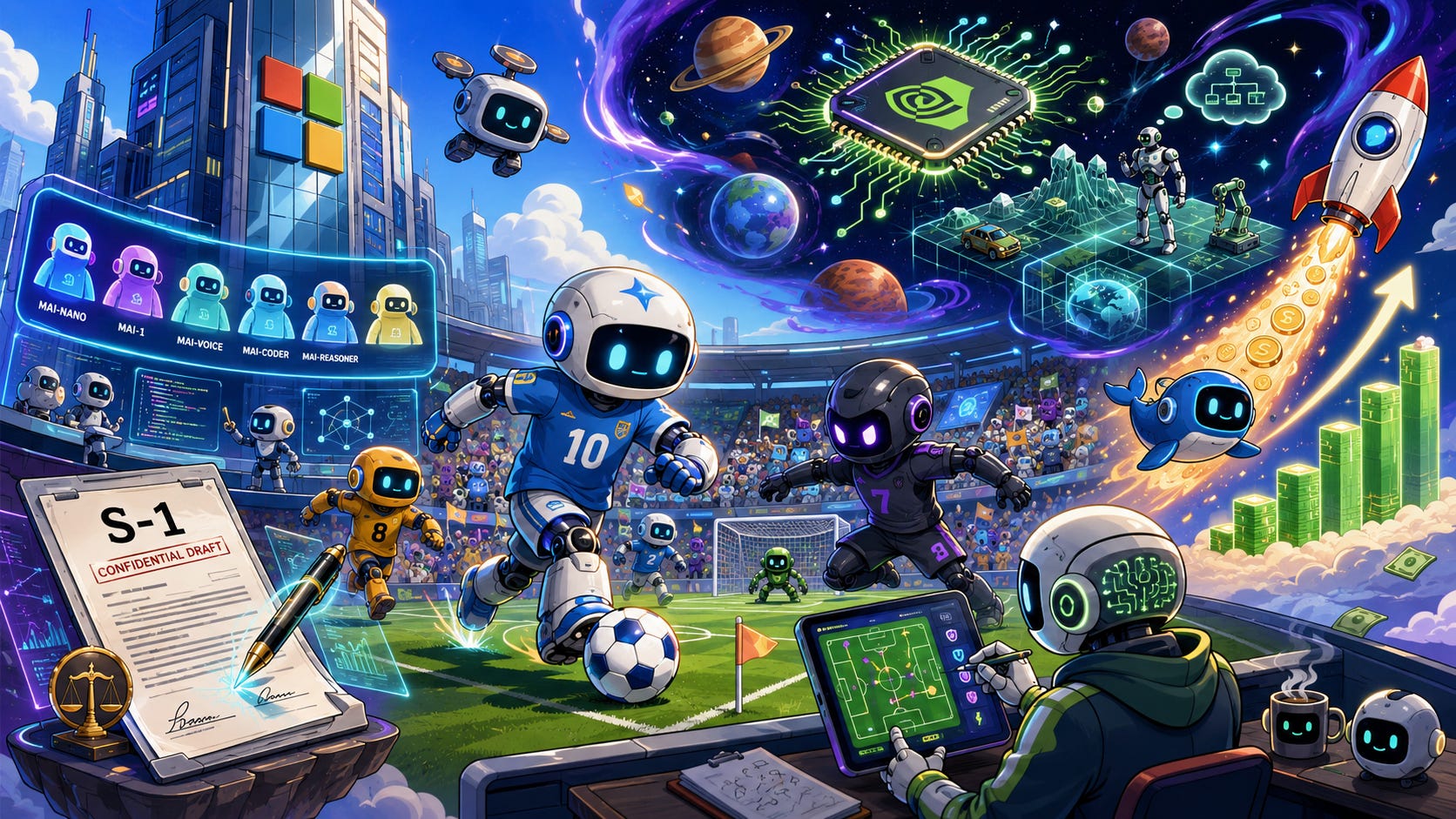
This week I want to start close to home. At LayerLens, we announced the Stratix Cup, a live tournament in which frontier AI models play soccer in a simulated environment. Season 1 brings together 16 models organized into four groups, with each model writing code to control a full team of players. Matches unfold in two halves, and models can adapt their strategy at halftime based on what happened on the field.
It is, admittedly, ridiculous in the best possible way: models chasing space, collapsing under pressure, inventing strange formations, and occasionally self-sabotaging in public. But the playfulness hides an important point. Evaluations need more arenas.
Most AI evals still behave like school exams: static, individual, decontextualized. They ask models to answer questions, solve coding problems, summarize documents, or reason through puzzles. These are useful, but they are incomplete. Soccer imposes a different discipline. It tests multi-agent planning, tactical adaptation, long-horizon credit assignment, robustness under adversarial pressure, and the ability to recover from mistakes. It also makes model behavior legible. You do not need a PhD to see when a model loses shape in midfield. That makes the failure modes both entertaining and intellectually honest, a rare combination in AI benchmarks.
The rest of the week echoed the same shift from models as artifacts to models as operating systems.
At Build, Microsoft introduced a new generation of MAI models across reasoning, coding, image, voice, and transcription. The headline is not just that Microsoft is building more of its own models. The strategic point is that the company wants a tighter loop between models, developer tools, agents, and devices. GitHub Copilot, agent security primitives, new model releases, and AI-native workflows all point to a world where AI is no longer a chat box bolted onto software. It is becoming the substrate running through work itself.
Anthropic’s confidential S-1 filing adds a different kind of gravity. The proposed IPO is not yet a public-market event, but it signals that frontier AI is moving from private-market mythology into public-market accountability. Revenue quality, compute commitments, margins, governance, and safety claims will eventually have to survive a much harsher evaluation suite: investors, regulators, and quarterly reporting.
NVIDIA, meanwhile, pushed the frontier in two complementary directions. Cosmos advances the idea of world foundation models for physical AI: systems that can reason about video, simulation, robotics, and embodied environments. Nemotron 3 Ultra expands NVIDIA’s enterprise model stack for demanding reasoning and agentic workflows. The implication is clear: NVIDIA is not merely selling the shovels for the AI gold rush. It wants to define the terrain where robots, agents, simulations, and enterprises are built.
Finally, DeepSeek’s reported new financing round is another reminder that the open-model race is becoming geopolitical infrastructure. Capital, energy, chips, talent, and industrial policy are converging around frontier labs. Open models are no longer just an engineering philosophy. They are becoming a strategic asset.
Put together, this week’s story is AI leaving the demo page. It is playing games, staffing workflows, filing S-1s, simulating the physical world, and attracting national-scale capital.
The question is no longer simply who has the best chatbot. It is which systems can act, adapt, and be trusted in environments that push back. Benchmarks told us how models answer. Arenas will tell us how they behave.
🔎 AI Research
Language Models Need Sleep: Learning to Self-Modify and Consolidate Memories
AI Lab: Google Research and Cornell University
Summary: This paper introduces a bio-inspired “Sleep” paradigm for large language models that enables continual learning and mitigates catastrophic forgetting. The approach features a memory consolidation stage that distills fragile short-term memories into stable long-term parameters, alongside a “Dreaming” phase where the model recursively self-improves using synthetically generated data.
Economy of Minds: Emerging Multi-Agent Intelligence with Economic Interactions
AI Lab: Harvard, MIT, GitHub, 2077 AI, and Kempner Institute
Summary: The Economy of Minds (EOM) framework enables a population of language agents to self-organize and evolve through decentralized economic interactions, such as bidding for the right to act and exchanging peer-to-peer payments. By relying on market selection to mutate wealthy, successful agents and eliminate bankrupt, ineffective ones, this system fosters emergent multi-step reasoning and outperforms stronger monolithic baselines across diverse tasks.
Cosmos 3: Omnimodal World Models for Physical AI
AI Lab: NVIDIA
Summary: Cosmos 3 introduces a unified Mixture-of-Transformers architecture that seamlessly integrates language, image, video, audio, and action sequences to serve as a versatile foundation for Physical AI. By consolidating multiple specialized functions—such as vision-language models, video generators, and world-action models—into a single framework, it achieves state-of-the-art performance across diverse understanding and generation tasks.
Qwen-Image-Flash: Beyond Objective Design
AI Lab: Qwen (Alibaba)
Summary: This paper explores the critical training components of few-step distillation—specifically data composition, step-wise multi-teacher guidance, and task mixture—demonstrating that effective distillation requires holistic pipeline optimization beyond just the objective function. Applying these insights, the authors developed Qwen-Image-Flash, an efficient unified model capable of executing both text-to-image generation and instruction-guided image editing with only four function evaluations.
Dreaming: Better memory for a more helpful ChatGPT
AI Lab: OpenAI
Summary: OpenAI has introduced a more scalable and compute-efficient memory architecture for ChatGPT that relies on a background process called “dreaming” to continuously curate and synthesize past conversations. By optimizing for freshness, continuity, and relevance, this new system significantly improves the model’s ability to recall factual context, follow user preferences, and adapt to changing information over time.
🤖 AI Tech Releases
Nemotron 3 - Ultra
NVIDIA released Nemotron 3 Ultra, optimized for long running agentic workflows.
MAI Models
Microsoft unveiled 7 new AI models including a flagship MAI-Thinking-1.
Gemma 4 12B
DeepMind released Gemma 4 12B, a multimodal intelligence model that can run locally on a laptop.
📡AI News You Need to Know About
Airbnb’s Brian Chesky plans a new AI lab — Airbnb CEO Brian Chesky intends to bankroll a new AI lab (reportedly focused on user interaction and design) while staying on as Airbnb’s CEO rather than running it himself. Original source: the Bloomberg scoop that broke it, since Airbnb declined to comment and issued nothing of its own →
Alphabet plans to raise $80B for AI buildout — Alphabet said it will sell $80 billion in stock (including $10 billion to Berkshire Hathaway) to fund AI infrastructure and compute amid demand outstripping supply. Original source: Alphabet’s own press release →
Coralogix raises $200M — The observability startup raised a $200M Series F (co-led by Advent, CPPIB, and Greenfield) at a $1.6B valuation, betting that monitoring autonomous AI agents will become core production infrastructure.
ZeroDrift raises $10M — The startup closed an oversubscribed $10M seed round (backed by a16z Speedrun and others) for its “compliance firewall,” which sits inline between AI systems and end users to catch and rewrite non-compliant AI-generated messages.
Anthropic files to go public — Anthropic confidentially submitted a draft S-1 to the SEC for a proposed IPO, days after a $65B Series H pushed its valuation near $1 trillion.
Meta sells an AI agent to businesses — Meta began charging for “Meta Business Agent,” an AI that handles customer conversations across WhatsApp, Messenger, and Instagram, as part of its push to monetize AI and diversify beyond ads.
DeepSeek close to a ~$7B funding round — DeepSeek is reportedly near finalizing roughly 50 billion yuan (~$7.4B) in its first external raise, led by Tencent, CATL, and founder Liang Wenfeng, at a ~$52–59B valuation. Note: there’s no primary source here — the deal is unconfirmed and the parties declined to comment — and the scoop originated with Reuters before Bloomberg corroborated it, so the
Google to pay SpaceX $920M/month for compute — Google will pay SpaceX ~$920M monthly from October 2026 through June 2029 for access to roughly 110,000 NVIDIA GPUs and related hardware as “bridge capacity” for Gemini Enterprise demand, announced a week before SpaceX’s IPO.