
The Sequence Radar #816: Last Week in AI: $110B Bets, Nano Banana 2, and the New Economic Reality
Massive OpenAI round, Anthropic drama and more model releases.
Next Week in The Sequence:
Our series about world models dives into DeepMind Genie.
The AI of the Week section discussed the new Qwen models.
In the opinion section we are going to give you an idea how AI chips are actually built.
Cant miss this!
Subscribe and don’t miss out:
📝 Editorial: Last Week in AI: $110B Bets, Nano Banana 2, and the New Economic Reality
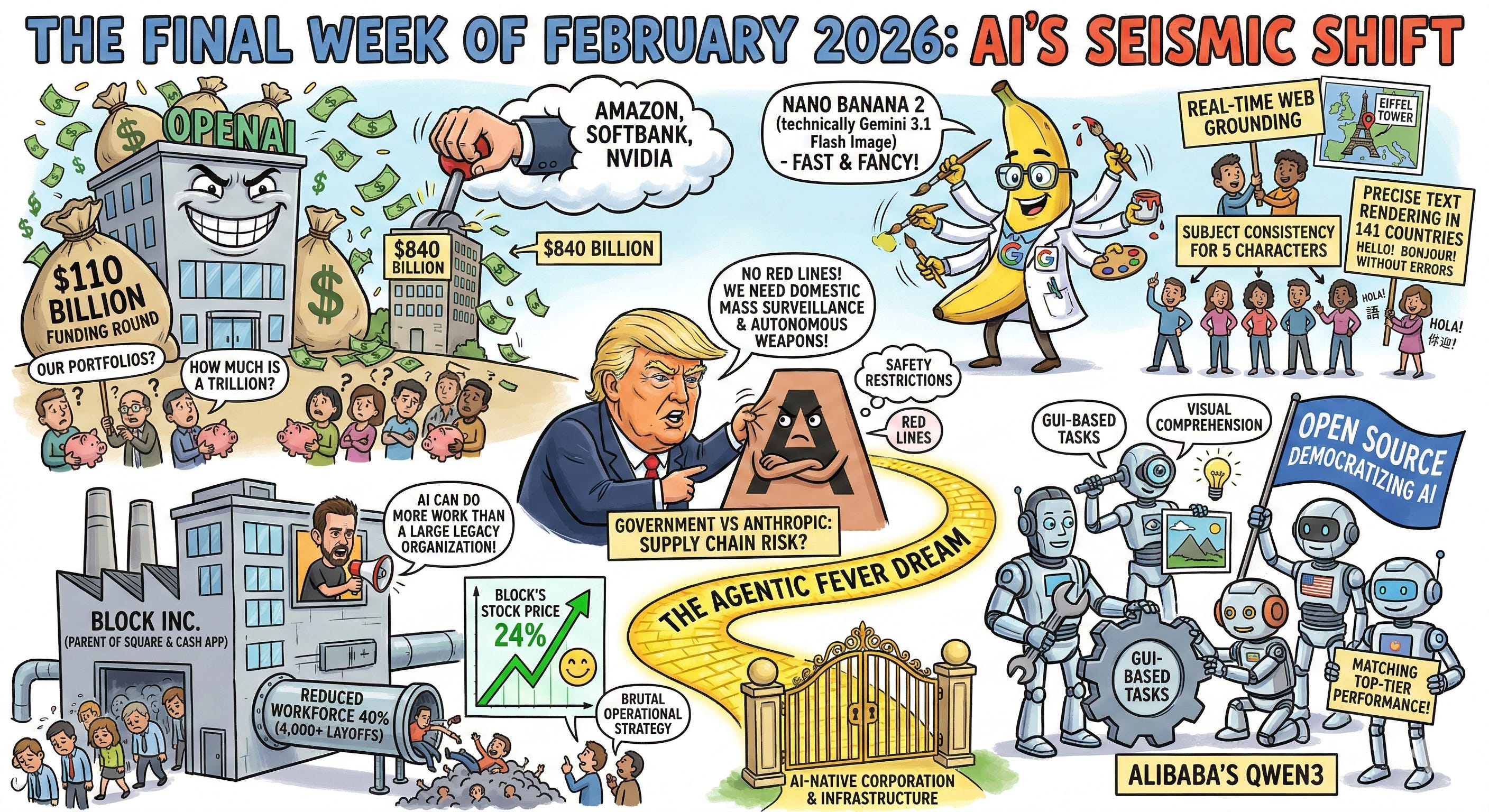
The final week of February 2026 has witnessed a seismic shift in the artificial intelligence landscape, defined by a high-stakes convergence of massive capital, creative breakthroughs, and a sobering new reality for the tech workforce. As the industry moves from experimental interfaces to an operational reality, the lines between software, labor, and national security are being redrawn in real-time.
The financial scale of this transition was made clear by OpenAI’s staggering $110 billion funding round. Valued at $840 billion and backed by a powerful coalition including Amazon, SoftBank, and Nvidia, this capital injection underscores the immense resources required to build the sovereign-level infrastructure of the next AI generation. This isn’t merely a vote of confidence; it is a global bet on the future of general intelligence.
While OpenAI secures the bank, Google is focused on the creative edge with the launch of Nano Banana 2 (technically Gemini 3.1 Flash Image). This new model merges the “studio-quality” capabilities of the previous Pro version with the lightning-fast speed of the Flash architecture. Nano Banana 2 introduces advanced features like real-time web grounding, which allows it to pull information from Google Search to accurately render specific landmarks, people, or products. With improved subject consistency for up to five characters and precise text rendering in 141 countries, it positions Google as a leader in production-ready AI tools for marketing and storytelling.
However, this rapid advancement has triggered a fierce geopolitical and regulatory backlash. Anthropic is currently locked in an escalating conflict with the U.S. government after President Trump ordered federal agencies to cease using its products. The dispute centers on Anthropic’s refusal to lift “red line” safety restrictions that prevent its models from being used for domestic mass surveillance or autonomous weapon systems. The government has designated Anthropic a “supply chain risk,” signaling a new era of tension between Silicon Valley’s safety mandates and the state’s security interests.
While the West grapples with regulation, the open-source ecosystem continues to democratize these capabilities globally. Alibaba’s Qwen3 releases have emerged as a formidable force, matching the performance of top-tier closed models. The new Qwen3 series has shown remarkable efficiency in GUI-based tasks and visual comprehension, proving that mid-range open-source models can now bridge the gap to the cutting edge.
Perhaps the most visceral impact of these advancements was felt in the corporate sector. Block Inc., the parent company of Square and Cash App, announced a 40% reduction of its workforce, laying off more than 4,000 employees despite reporting strong profits. CEO Jack Dorsey explicitly attributed the cuts to the “compounding” capabilities of AI tools, stating that a significantly smaller team can now do more work than a larger legacy organization. This move—rewarded by a 24% surge in Block’s stock price—serves as a clear signal that the “AI-native” corporation is no longer a theoretical concept but a brutal operational strategy.
As we look at the week in review, the narrative is clear: we are entering a phase where AI is not just a tool for productivity, but the very infrastructure upon which companies and governments are being rebuilt. The “agentic fever dream” has arrived, bringing with it unprecedented power and profound human consequences.
🔎 AI Research
Decoding ML Decision: An Agentic Reasoning Framework for Large-Scale Ranking System
AI Lab: Meta
Summary: This paper introduces GEARS, a framework that reimagines ranking optimization as an autonomous discovery process within a programmable experimentation environment. It utilizes specialized agent skills and validation hooks to translate ambiguous product intent into robust, near-Pareto-efficient ranking policies.
On Data Engineering for Scaling LLM Terminal Capabilities
AI Lab: NVIDIA
Summary: The paper presents Terminal-Task-Gen, a synthetic data generation pipeline designed to improve the command-line proficiency of large language models. Using this pipeline, the authors trained the Nemotron-Terminal family of models, which achieved state-of-the-art results on the Terminal-Bench 2.0 benchmark.
CORPGEN: Simulating Corporate Environments with Autonomous Digital Employees in Multi-Horizon Task Environments
AI Lab: Microsoft Corporation
Summary: This paper introduces CORPGEN, a framework designed to help autonomous agents manage dozens of concurrent, interleaved, and interdependent long-horizon tasks within persistent execution contexts. By implementing hierarchical planning and tiered memory, the architecture addresses common failure modes like context saturation and memory interference, achieving up to a 3.5x improvement in task completion over baseline agents.
The Design Space of Tri-Modal Masked Diffusion Models
AI Lab: Apple and Google DeepMind
Summary: This study introduces the first tri-modal Masked Diffusion Model (MDM) pretrained from scratch on text, image, and audio data. The research establishes scaling laws for multimodal discrete diffusion and demonstrates strong cross-modal generation capabilities at a 3B parameter scale.
Agents of Chaos
AI Lab: Northeastern University, Stanford University, MIT, and others
Summary: This exploratory red-teaming study examines autonomous AI agents deployed in a live laboratory environment with access to tools like email, Discord, and shell execution. The authors document various security and safety failures, such as unauthorized compliance and destructive system-level actions, arising from the integration of language models with autonomy.
🤖 AI Tech Releases
Nano Banana 2
Google released Nano Banana 2, the new version of its super impressive image generation model.
Perplexity Computer
Perplexity unveiled a new multi-model agentic solution.
Qwen Models
Alibaba Qwen open sources a new series of compute efficiency models.
Hermes Agent
Nouse Research released Hermes Agent, a new AI agent optimized for personal workflows.
📡AI News You Need to Know About
OpenAI Closes Historic $110B Funding Round: OpenAI raised $110 billion at an $840 billion post-money valuation. The round was led by Amazon ($50B), SoftBank ($30B), and Nvidia ($30B). As part of the deal, OpenAI will utilize Amazon’s Trainium chips and has committed $100 billion to AWS over the next eight years to scale its global infrastructure.
Trump Orders Federal Ban on Anthropic: Following an impasse between the Pentagon and Anthropic over ethical guidelines, President Trump ordered all federal agencies to “immediately cease” using Anthropic technology. The administration has designated the company a “supply-chain risk” after CEO Dario Amodei refused to lift safety “red lines” regarding the use of Claude in autonomous weapon systems.
Block Lays Off 40% of Staff in AI Pivot: CEO Jack Dorsey announced that Block Inc. (parent of Square and Cash App) is reducing its workforce from 10,000 to just under 6,000 employees. Dorsey explicitly cited AI as the driver, stating that “intelligence tools have changed what it means to build and run a company,” allowing significantly smaller teams to outperform legacy structures.
Meta Strikes $100B AMD Chip Deal: Meta entered a massive agreement with AMD to purchase MI450 AI chips for its data centers. The deal includes a performance-based warrant allowing Meta to acquire up to a 10% stake in AMD as it builds toward “personal superintelligence.”
Nvidia Reports Record $68B Revenue, Declares “Agentic AI Inflection Point”: Nvidia released its Q4 fiscal 2026 results, reporting record quarterly revenue of $68.1 billion—up 73% year-over-year. Data Center revenue alone hit $62.3 billion, driven by the massive platform shift toward accelerated computing. CEO Jensen Huang stated that “enterprise adoption of agents is skyrocketing,” and provided a bullish outlook for the coming year as companies race to build “AI factories.”
MatX Raises $500M to Challenge Nvidia: Founded by former Google TPU engineers, MatX raised a $500M Series B led by Jane Street. The startup aims to build specialized LLM processors that deliver 10x the training performance of current GPUs. [Source: MLQ.ai]
Anthropic Acquires Vercept: To accelerate its “computer use” vision, Anthropic acquired Vercept, a startup focused on AI perception within software interfaces. The Vercept team will help Claude navigate live applications with human-like visual understanding.
Mistral AI Joins Forces with Accenture: Mistral AI announced a multi-year partnership with Accenture to scale its open-weight models for enterprise use across Accenture’s global client base.
Basis AI Hits $1.15B Valuation: The AI-for-accounting startup Basis raised $100M, becoming a unicorn. The platform uses “long-horizon agents” to autonomously handle complex tax returns and financial audits.