
The Sequence Opinion #823: SaaSmagedon, Is SaaS Dead?: Vibe Coding, Agentic Engineering, and the Collapse of the Code Moat
The end of SaaS might be exagerated. Right?
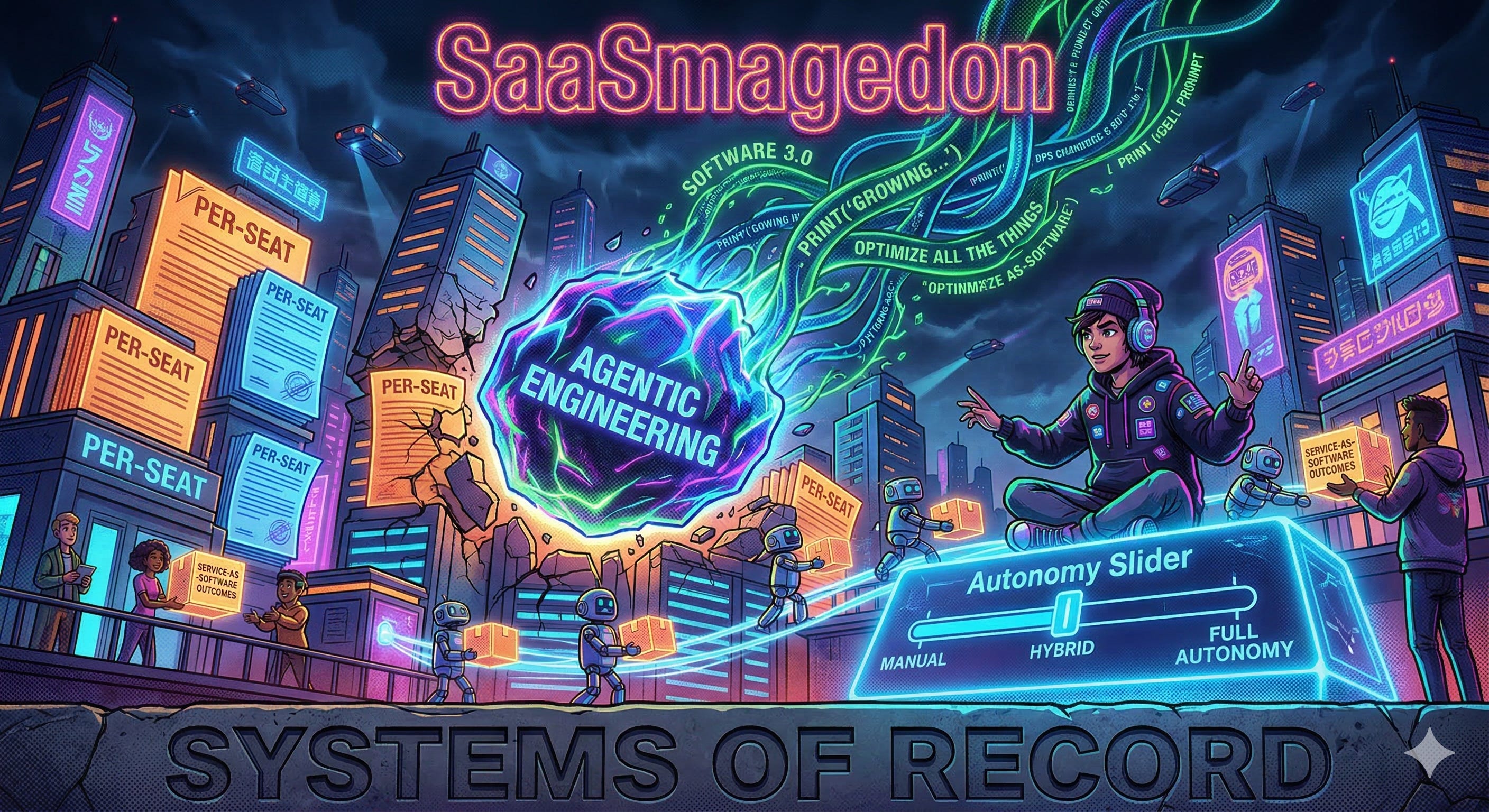
The software industry is currently navigating a phase transition of unprecedented magnitude, an event frequently characterized in financial and technical circles as SaaSmagedon or the SaaS-pocalypse. This period is marked not by a mere cyclical downturn, but by a structural re-evaluation of the entire $1 trillion software ecosystem. In early 2026, the market witnessed a massive sell-off where over $1 trillion in market capitalization was erased from software stocks in a single week. On January 29, 2026, the sector experienced its most significant decline since the 2020 pandemic volatility, with incumbents like ServiceNow dropping 11% despite exceeding earnings expectations, and Microsoft shedding $360 billion in market value in a single trading session.2 This violent repricing reflects a growing realization that the core tenets of the Software-as-a-Service (SaaS) model—per-seat pricing, human-centric interfaces, and the “code moat”—are being fundamentally dismantled by the rapid maturation of autonomous AI agents and the emergence of “Vibe Coding” and “Agentic Engineering”.
The underlying friction is a shift in the fundamental “stack” of computation. The industry is moving from Software 1.0, characterized by human-written code, to Software 2.0, defined by neural network weights, and now into Software 3.0, where Large Language Models (LLMs) function as the primary engine, programmed through natural language prompts. This transition is not merely a change in tooling; it is a change in the biology of how software is born, distributed, and monetized. Traditional SaaS applications, once seen as sophisticated platforms, are being reframed as simple “CRUD” (Create, Read, Update, Delete) databases wrapped in business logic that can now be automated by agents.9 Consequently, the industry is witnessing the birth of “Service-as-Software” (SaS), where the product is no longer a tool for a human to do work, but an autonomous outcome delivered directly by an agent.