
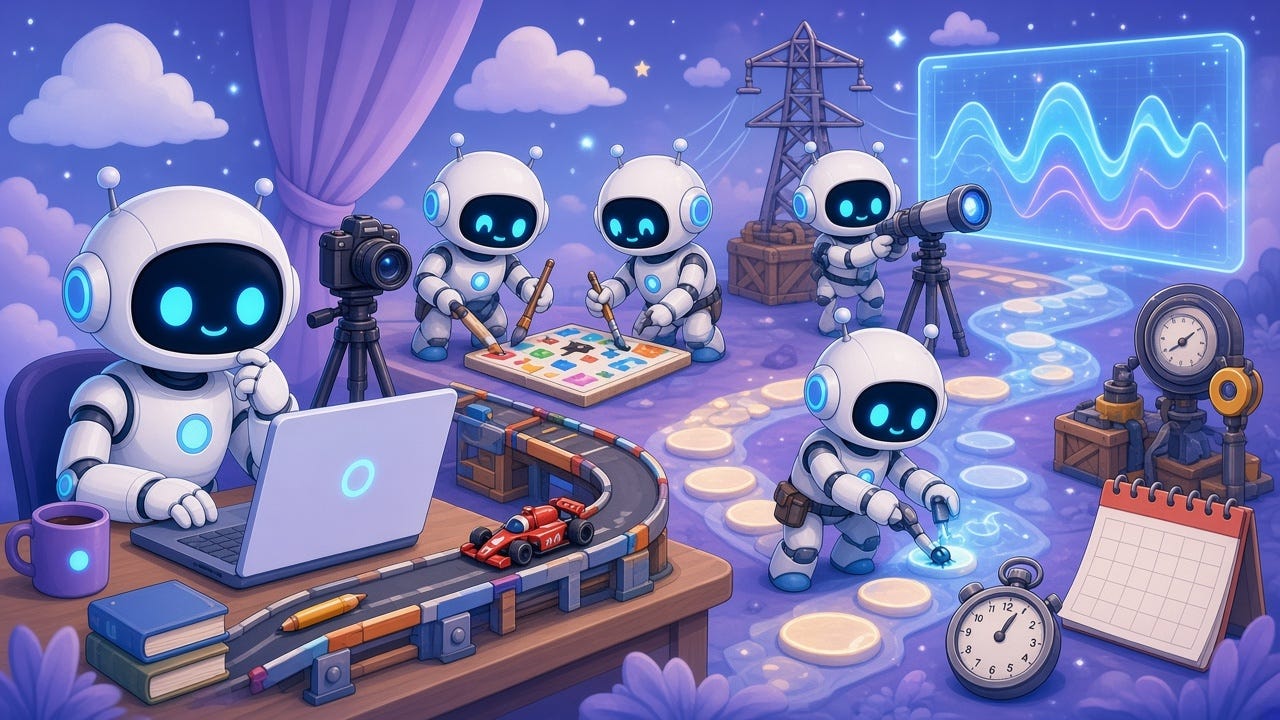
TLDR: Useful AI increasingly depends on matching the model, its inputs, and its feedback to the job. Gemini 4 Argon turns inputs such as photographs into finished artifacts through tools and subagents, according to Google’s curated demonstrations, while Gemini 4 Carbon targets longer engineering and cybersecurity work, where small gains in per-step reliability compound across a whole task. Mistral’s Timestral brings pretrained, zero-shot forecasting to numerical series, with quantile outputs that express uncertainty.
We cover how to evaluate an Argon-based system on completed projects, why duration and an external signal matter for Carbon-style agents, and how Timestral handles multiple series, future-known information, and synthetic pretraining. We close with a proposed design that pairs a numerical forecaster with a generalist agent, using clear, checkable interfaces between them.
Imagine giving an AI two jobs. Turn photographs of a desk into a playable racing game. Then predict tomorrow’s electricity demand. The first requires visual understanding, code, tools, and repeated correction. The second requires learning how numerical signals evolve, including how uncertain their futures are. Both involve prediction. They demand very different machinery.
That is what makes Google’s latest Gemini developments and Mistral’s Timestral interesting together. One direction extends the amount of work we can delegate to a generalist. The other brings pretrained intelligence to the numerical streams running through businesses. My reading of the week is that useful AI increasingly depends on matching the model, its inputs, and its feedback to the job.