
The Sequence 802: The Thinking Machine: A Deep Dive into Test-Time Compute and the New Scaling Paradigm
A deep dive into one of the techniques that really influenced AI last year.
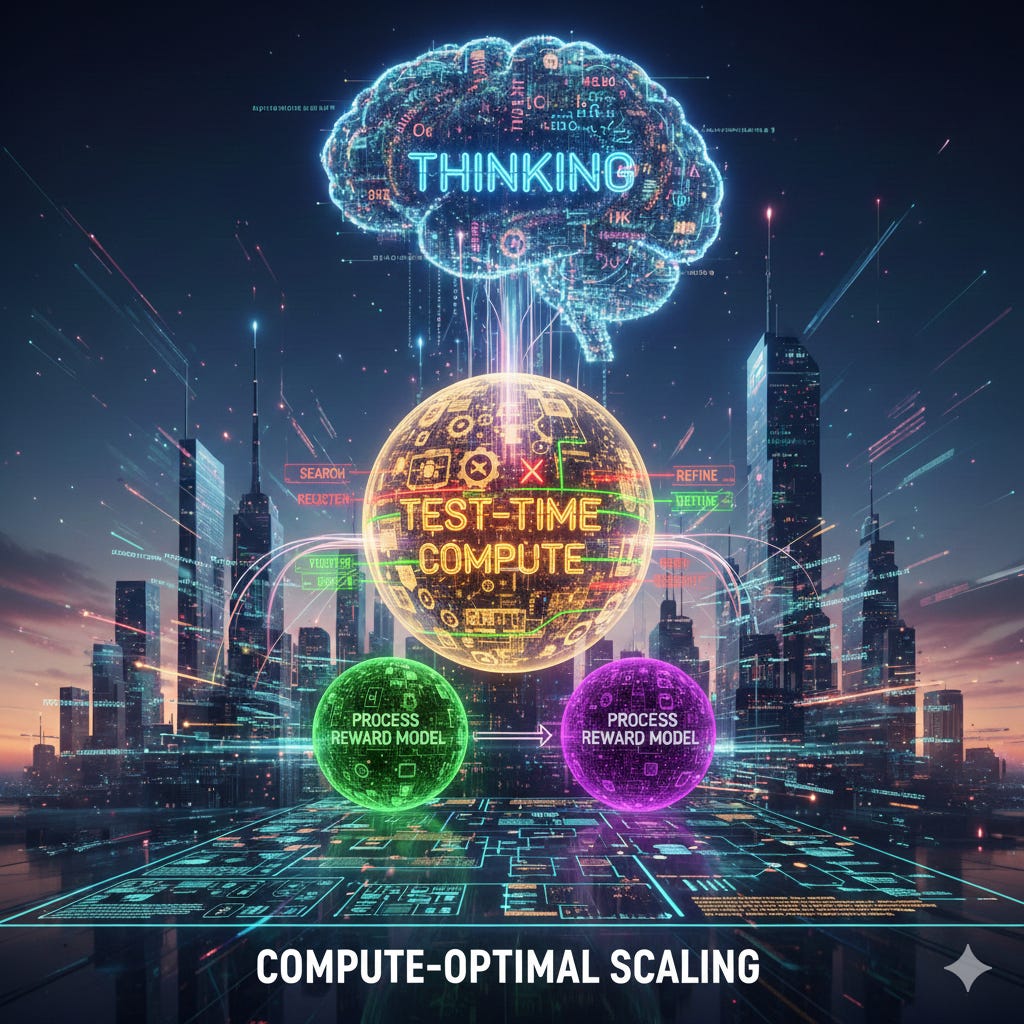
The field of artificial intelligence is currently undergoing a metabolic shift. For the better part of a decade, the dominant strategy for advancing machine intelligence has been a relentless pursuit of scale during the pre-training phase. The recipe was deceptively simple: collect more data, build larger transformer architectures with more parameters, and burn exponentially more GPU hours to compress that data into a static set of weights. This approach, governed by scaling laws, operated on a fundamental assumption: that intelligence is primarily a function of pattern recognition capability acquired before a user ever types a prompt.
However, a new frontier has emerged, one that challenges the supremacy of pre-training as the sole driver of capability. It is the domain of Test-Time Compute—often colloquially referred to as “system 2” thinking, inference-time scaling, or simply “letting the model think”. This paradigm suggests that the performance of a model is not just a function of how much biological energy was spent training it, but also how much computational energy it is allowed to expend while solving a specific problem. By shifting compute from the training cluster to the inference server, we are witnessing the emergence of models that can reason, plan, backtrack, and self-correct in ways that standard autoregressive models simply cannot.